
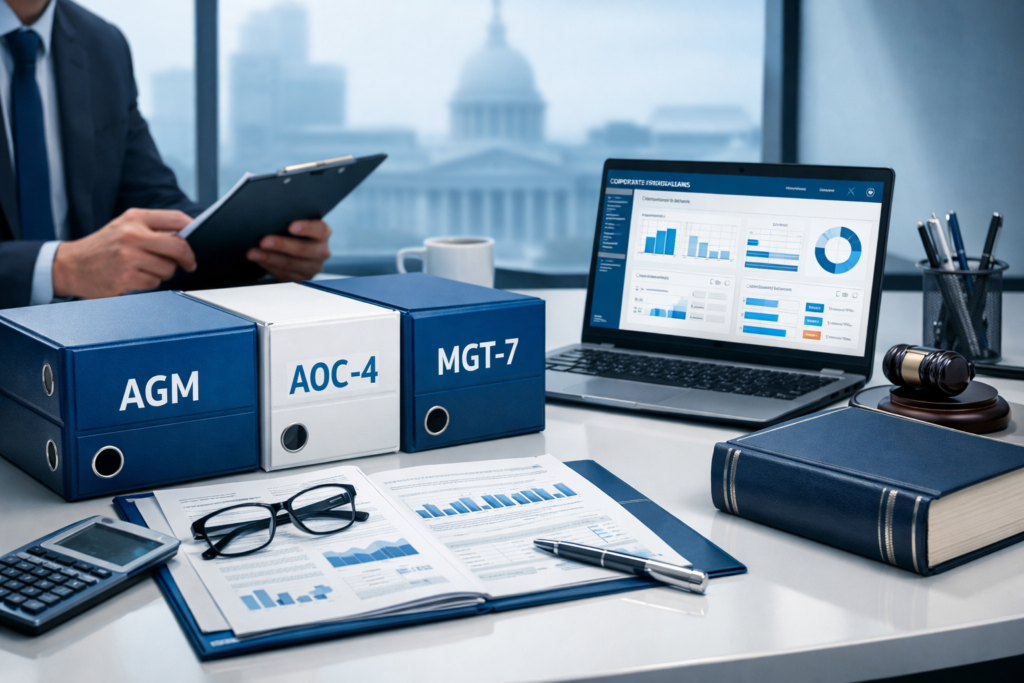
Can Companies Hold Pending AGMs Now and Still Avail CCFSS Benefits? – A Practical Guide
Introduction
With the introduction of the Condonation of Delay Scheme (CCFSS) by the Ministry of Corporate Affairs (MCA), many companies—especially inactive or non-compliant entities—are exploring whether they can regularize past non-compliances.
One of the most common questions being asked is:
Can a company that failed to hold Annual General Meetings (AGMs) for previous years now conduct them and still benefit from the CCFSS Scheme?
The answer is Yes—but with an important caveat.
This article explains the legal position, practical approach, and compliance strategy in a clear and actionable manner.
Background of the Issue
Many companies have:
The Finance Bill 2026 proposes a clarification on valuation of supply under Section 15 of CGST Act, especially concerning:
- Not prepared financial statements for several years
- Failed to hold AGMs within statutory timelines
- Consequently, not filed mandatory forms like:
- AOC-4 (Financial Statements)
- MGT-7 / MGT-7A (Annual Returns)
With the CCFSS Scheme offering significant relief in additional filing fees, companies are now trying to clean up past defaults.
Legal Requirement: Holding AGM (Section 96)
Under Section 96 of the Companies Act, 2013:
- Every company must hold an AGM:
- Within 6 months from the end of the financial year
- Gap between two AGMs must not exceed 15 months
If a company fails to comply, it is considered a statutory default.
Penalty for Non-Compliance (Section 99)
Failure to hold AGM attracts penalties under Section 99:
- Fine up to ₹1,00,000, and
- In case of continuing default:
- ₹5,000 per day
This liability applies to:
- The company, and
- Officers in default
Does CCFSS Provide Immunity from AGM Default?
This is where many professionals get confused.
What CCFSS Covers:
- Waiver/reduction of additional filing fees
- Relief on delayed filing of forms
❌ What CCFSS Does NOT Cover:
- It does NOT waive statutory violations
- It does NOT remove default under Section 96
Therefore, even if filings are completed under the scheme,
the AGM default still exists legally.
Practical Scenario Explained
Let’s understand this with an example:
A company has:
- Not prepared financials for 3–4 years
- Not held AGMs during that period
Now, the company:
- Prepares financial statements
- Conducts delayed AGMs
- Files AOC-4 and MGT-7 under CCFSS
Result:
✅ Benefit: Reduced additional filing fees
❌ Issue remains: Default of AGM under Section 96
Compounding of Offence – Mandatory Step
Since the default already occurred:
The company must:
- Apply for compounding of offence for violation of Section 96 read with Section 99.
- Pay penalty as determined by authority
This is a separate compliance requirement and cannot be avoided through CCFSS.
Step-by-Step Compliance Strategy
To regularize past non-compliances, companies should follow this structured approach:
Step 1: Finalize Financial Statements
Prepare all pending financials for previous years.
Step 2: Conduct Board Meeting
- Approve financial statements
- Approve AGM notice
Step 3: Hold AGM (Even if Delayed)
Conduct AGM for each pending year.
Step 4: File Pending Forms
- File AOC-4
- File MGT-7 / MGT-7A
Avail benefit of reduced additional fees under CCFSS
Step 5: Apply for Compounding
- File application for violation under Section 96
- Pay applicable penalties under Section 99
Key Takeaways

✔ Companies can conduct pending AGMs now
✔ They can avail CCFSS benefits for filings
❌ But they cannot escape AGM default penalties
✔ Compounding is mandatory to close the non-compliance
The CCFSS Scheme is a golden opportunity for companies to regularize long-pending filings at a significantly reduced cost. However, it is important to understand that:
Filing compliance and statutory compliance are two different aspects.
While delayed filings can be rectified under the scheme, failure to hold AGM within time remains a punishable offence.
While delayed filings can be rectified under the scheme, failure to hold AGM within time remains a punishable offence.
A well-planned compliance strategy—combining filing + compounding—is essential to achieve complete legal closure.
Need help regularizing your company compliances?
At Vizttax, we specialize in:
- Backlog compliance management
- ROC filings (AOC-4, MGT-7, etc.)
- Compounding of offences
- End-to-end corporate compliance solutions