
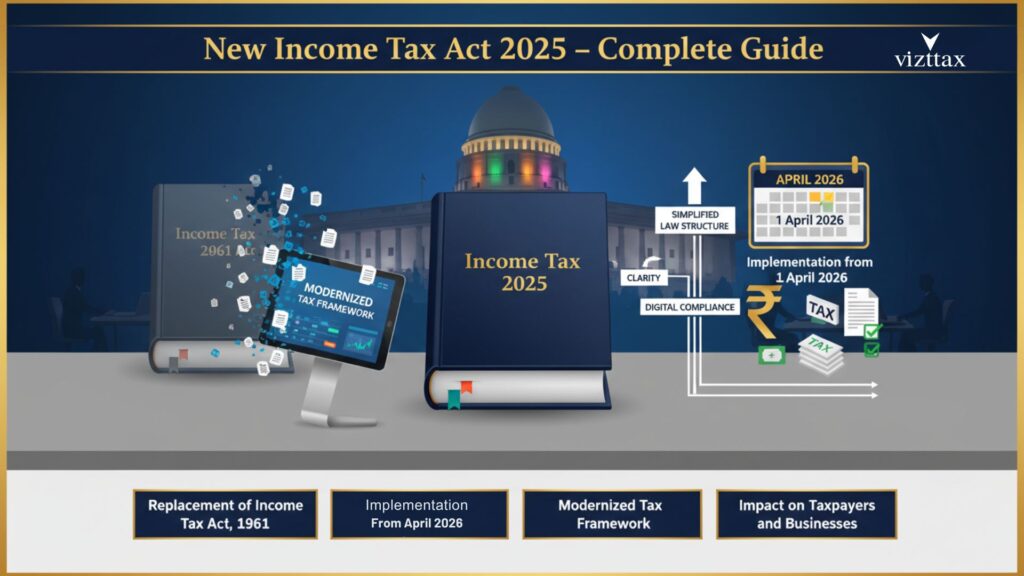
New Income Tax Act 2025 – Complete Guide to the Income Tax Act, 2025
India has introduced one of the most significant reforms in its direct taxation framework through the enactment of the Income Tax Act, 2025. This legislation replaces the long-standing Income Tax Act, 1961, which has governed the country’s income tax system for more than six decades.
Although the new Act has already been enacted and notified by the government, it comes into force from 1 April 2026, meaning it will apply to income earned from the Financial Year 2026–27 onwards.
This article provides a comprehensive guide to the New Income Tax Act applicable from 2026, explaining its objectives, structure, major changes, and expected impact on taxpayers and businesses.
1. Background of the New Income Tax Act
India’s existing income tax framework was established in 1961, at a time when the country’s economy was significantly smaller and less complex. Over the decades, the law has undergone numerous amendments to accommodate economic changes, policy reforms, and judicial interpretations.
However, the continuous amendments resulted in several challenges:
- The law became lengthy and difficult to interpret
- Multiple explanations, provisos, and cross-references created confusion
- Tax compliance became more complicated for businesses and individuals
- Litigation between taxpayers and tax authorities increased
To address these challenges, the government enacted the Income Tax Act, 2025, which restructures the legislation and simplifies many provisions.
2. Applicability of the New Income Tax Law
The Income Tax Act, 2025 has already been passed and notified. However, its provisions are scheduled to come into effect from 1 April 2026.
This means:
| Financial Year | Applicable Law |
|---|---|
| FY 2025-26 | Income Tax Act, 1961 |
| FY 2026-27 onwards | Income Tax Act, 2025 |
Therefore, income earned from 1 April 2026 will be governed by the new tax framework.
Taxpayers and professionals should start preparing early to understand the structural changes introduced in the new law.
3. Key Objectives of the Income Tax Act, 2025
The new tax legislation focuses primarily on simplification rather than radical policy change.
The major objectives include:
Simplification of Tax Laws
The Act reorganizes provisions and uses simpler language to make the law easier to understand.
Reduction in Litigation
Clearer drafting and better structure are expected to reduce interpretational disputes.
Technology-Driven Tax Administration
The tax administration under the Income Tax Department will continue to become more digital and automated.
Improved Transparency
The law supports greater financial transparency by strengthening reporting systems and data analytics.
4. Simplified Structure of the New Law
One of the most notable reforms introduced by the Income Tax Act, 2025 is the restructuring of the entire legislation.
Over time, the old law accumulated numerous amendments, making it difficult to navigate. The new Act reorganizes provisions into a more logical structure.
Key improvements include:
- Reduction in unnecessary provisions
- Removal of redundant explanations
- Better grouping of related sections
- Simplified definitions and terminology
The goal is to make the law more accessible to taxpayers and professionals.
5. Major Heads of Income Under the New Act
The fundamental structure of income taxation remains largely the same. The new law continues to classify income under the following heads:
Income from Salary
This includes wages, allowances, bonuses, perquisites, and other employment benefits.
Income from House Property
Income earned from renting or leasing property continues to be taxed under this category.
Profits and Gains from Business or Profession
Business income and professional earnings will continue to be governed under this head with simplified deduction rules.
Capital Gains
Profits arising from the sale of assets such as real estate, shares, or investments will continue to be taxed under capital gains provisions.
Income from Other Sources
Any income not falling under the above categories, such as interest income, gifts, and certain investments, will be taxed under this head.
Although the categories remain similar, the provisions within each category have been simplified.
6. Digital Transformation of Tax Administration
India’s tax administration has already undergone significant digital transformation in recent years.
Programs like the Faceless Assessment Scheme have reduced the need for physical interaction between taxpayers and tax authorities.
The new Income Tax Act continues this transformation by encouraging:
- Pre-filled income tax returns
- Automated data matching
- Digital notices and communications
- Online dispute resolution mechanisms
These measures are expected to improve efficiency and reduce administrative delays.
7. Changes in Reporting of Financial Transactions
The new tax framework strengthens monitoring of high-value financial transactions.
Financial institutions may report certain transactions to the tax authorities, including:
- Large cash deposits or withdrawals
- Property purchases and sales
- High-value investments
- Luxury consumption patterns
These reporting mechanisms help the tax department compare financial transactions with income declared in tax returns.
Such systems improve tax compliance while helping detect potential cases of tax evasion.
8. Impact on Businesses
Businesses are expected to benefit from several improvements under the new tax law.
Clearer Deduction Rules
Simplified provisions will help businesses understand allowable expenses and deductions.
Improved Compliance Processes
Digital integration will reduce paperwork and improve efficiency.
Reduced Litigation
Better drafting of provisions may reduce disputes with tax authorities.
Integration with Other Laws
The tax framework will work more efficiently alongside laws such as the Goods and Services Tax, enabling smoother regulatory compliance.
However, businesses must maintain accurate records because the tax department increasingly relies on data analytics.
9. Benefits for Individual Taxpayers
The new income tax framework also provides several advantages for individuals.
Easier Tax Filing
Simplified forms and pre-filled data can make filing returns easier.
Better Transparency
Taxpayers can clearly understand the rules regarding deductions and reporting.
Faster Processing
Digital systems may accelerate processing of returns and refunds.
Reduced Compliance Burden
Simplified provisions reduce confusion and make the law easier to interpret.
10. Transitional Challenges
Although the new Act aims to simplify the tax system, the transition may initially create some challenges.
Learning Curve for Professionals
Tax professionals must study the new structure and adapt their advisory practices.
System Updates
Accounting and compliance software may require updates.
Interpretation Issues
New provisions may initially require clarification through circulars and judicial decisions.
However, such challenges are common during major legal reforms and are expected to stabilize over time.
11. What Taxpayers Should Do Now
Since the new tax law will apply from April 2026, taxpayers should start preparing in advance.
Important steps include:
- Staying updated with notifications and rules issued by the government
- Reviewing accounting and compliance systems
- Maintaining accurate financial records
- Seeking professional tax advice where necessary
Early preparation will help avoid compliance issues when the new law becomes fully operational.
12. Future Outlook of India’s Tax System
The Income Tax Act, 2025 represents a significant modernization of India’s direct tax framework.
By focusing on simplification, digitalization, and transparency, the government aims to create a tax system that is easier to understand and more efficient to administer.
If implemented effectively, the new law could reduce litigation, improve compliance, and create a more taxpayer-friendly environment.
Tax laws in India are evolving rapidly, and staying compliant requires proper understanding and professional guidance.

If you need assistance with:
- Income Tax Advisory
- Business Tax Planning
- Tax Compliance and Filing
- Understanding the New Income Tax Act applicable from 2026
Our experts at Vizttax are here to help.
Contact us today for expert assistance with your tax and compliance requirements.
Vizttax – Your Trusted Partner in Taxation and Compliance.