

Since its implementation, the Goods and Services Tax (GST) has become one of India’s most complex indirect tax systems. While it aims to simplify compliance, in reality, it has also opened the door to a rising number of departmental notices, audits, and litigations.
At Vizttax, we have seen that most companies don’t lose GST cases because they are non-compliant — they lose because their documentation, process discipline, and strategic defence are weak.
This article breaks down the five key reasons companies lose GST cases and provides practical steps to build a strong defence that can stand firm during audits, investigations, and appeals.
Let’s explore the Four biggest GST risks that can silently drain your profits and the practical ways to eliminate them.
1. Poor Documentation — The First and Fastest Reason for Losing ITC and Cases

When GST officers question your Input Tax Credit (ITC) or transactions, they don’t just look for compliance — they look for proof.
Even a small missing document — such as a delivery challan, agreement, or e-way bill — can make a genuine transaction look suspicious.
Impact:
Loss of eligible ITC, delayed refunds, and penalties even when the transaction was genuine.
How to Defend:
- Maintain a digital GST file for each financial year with invoices, e-way bills, purchase orders, and reconciliation statements.
- Keep all vendor agreements, payment proofs, and correspondence ready for cross-verification.
- Use cloud-based accounting or document storage integrated with your ERP for instant retrieval during departmental inspections.
2. Supplier Non-Compliance — The Silent Killer of ITC Claims
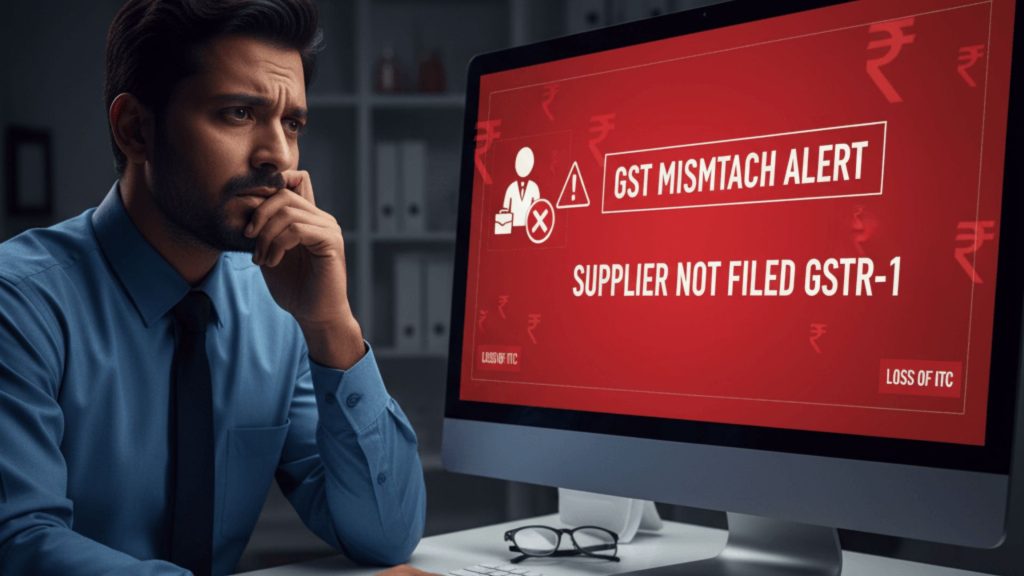
Even though your transaction is genuine, the department can deny your ITC simply because the supplier didn’t comply.
Impact:
You end up paying tax twice — once to the supplier and again in cash when ITC is blocked.
How to Defend:
- Pay GST to vendors only after invoices appear in your GSTR-2B
- Conduct monthly vendor compliance checks using GSTR-2B or supplier scorecards.
- Retain communication proofs showing follow-ups made to suppliers — these serve as strong defence during disputes.
- Build an ITC control system that flags non-compliant vendors before the filing date.
3. Weak or Inconsistent Replies to Show Cause Notices (SCN)

Many companies lose GST cases not because of facts, but because of weak replies to departmental notices.
A reply lacking evidence, legal references, or structure gives officers a reason to issue adverse orders.
Impact:
Orders passed without considering your submissions — leading to avoidable appeals.
How to Defend:
- Always reply to SCNs formally, on letterhead, and with supporting evidence.
- Quote relevant sections, rules, CBIC circulars, or tribunal judgments to substantiate your claim.
- Maintain a GST Litigation File containing SCNs, replies, and acknowledgment proofs.
- Never ignore or casually respond to DRC-01 or ASMT notices — every reply forms part of your case record.
4. Lack of Internal Reconciliation and Audit Trail
During audit or scrutiny, the officer compares data from GSTR-1, GSTR-3B, GSTR-9, e-way bills, and your financial books.
Even small mismatches — like turnover variation or ITC mismatch — can lead to large demands if not explained with clarity.
Impact:
Assessment orders and DRC-07 demands even for minor reporting differences.
How to Defend:
- Conduct monthly GSTR-2B vs. books reconciliation and annual GST audit trail verification.
- Keep a working paper showing how GST returns tie to audited financials.
- Ensure that your accounting team and GST consultants coordinate on reconciliations and adjustments before filing annual returns.
5. Absence of a Litigation Strategy and Follow-up

GST litigation is not a one-step process — it involves replies, hearings, orders, appeals, and sometimes tribunals.
Many companies lose cases because they fail to track deadlines, file appeals on time, or maintain continuity of representation.
Impact:
Orders become final or unappealable due to limitation period expiry.
How to Defend:
- Develop a GST litigation tracker listing all notices, deadlines, and status updates.
- Always acknowledge every communication and keep digital copies.
- Engage a professional who understands both GST law and procedural defence, not just compliance filing.
- File appeals within the prescribed time (usually 3 months) with strong documentation and representation.
Building a Strong GST Defence Framework
A winning GST defence is not built during a dispute — it’s built much earlier through discipline and systems.
At Vizttax, we help companies build preventive GST frameworks that combine compliance, control, and documentation.
Our approach ensures that even if a case arises, your position remains legally strong and well-documented from day one.
Checklist for a Strong GST Defence:
- Monthly 2B vs. books reconciliation
- Vendor compliance monitoring
- Centralized digital GST record-keeping
- Standardized SCN reply templates
- Annual GST health check and litigation review
Conclusion: In GST, Your Defence Is Built Before the Battle
Litigation is inevitable in today’s GST environment — but losing it is not.
Companies that maintain strong documentation, legal awareness, and timely response systems are far better positioned to protect their ITC, reputation, and cash flow.
At Vizttax, we don’t just file GST returns — we help you build a GST defence system that stands firm, year after year.