

The Ministry of Corporate Affairs (MCA) has notified the Companies (Specification of Definition Details) Amendment Rules, 2025 through G.S.R. 880(E) dated 1st December 2025.
This amendment revises the financial thresholds that determine whether an entity qualifies as a Small Company under Section 2(85) of the Companies Act, 2013.
This update is significant, especially for startups, MSMEs, and growing private limited companies, as it extends the scope of entities eligible for several compliance relaxations.
1. What Is a Small Company? – Legal Definition (Revised in 2025)

Under Section 2(85) of the Companies Act, 2013, a Small Company is a company (other than a public company) that meets the prescribed financial limits notified by the Central Government.
Revised Thresholds (Effective 1st December 2025):
A company is considered a Small Company if it satisfies both of the following conditions:
| Parameter | Earlier Limit | Revised Limit (2025) |
|---|---|---|
| Paid-up Share Capital | Up to ₹4 crore | Up to ₹10 crore |
| Turnover* | Up to ₹40 crore | Up to ₹100 crore |
*(as per latest audited financials)
These revised limits apply from the date of publication in the Official Gazette.
2. Which Companies Are Not Considered Small Companies?
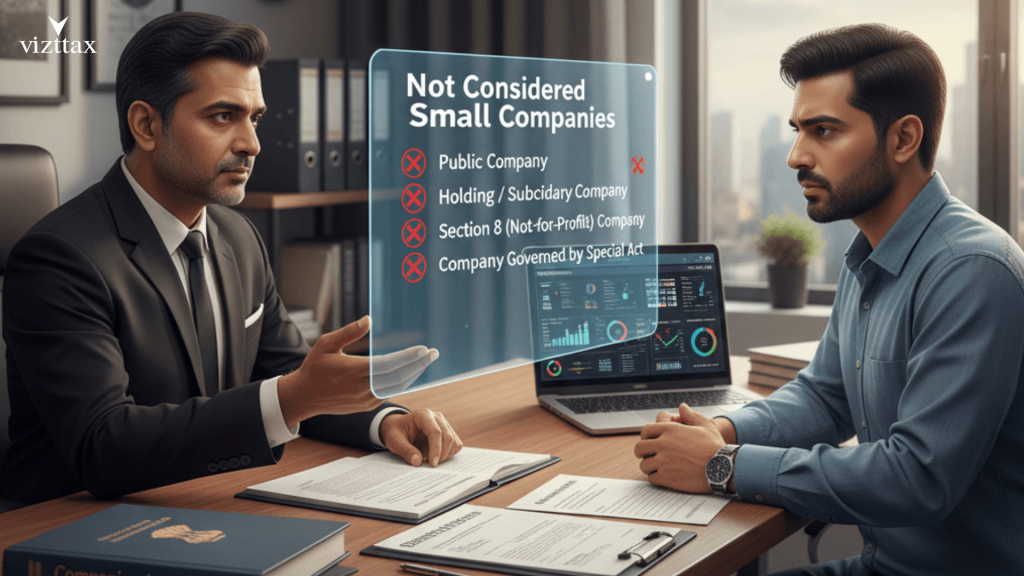
Even if the above limits are fulfilled, the following entities cannot be classified as small companies:
- Public companies
- Holding or subsidiary companies
- Companies registered under Section 8 (Not-for-Profit)
- Companies governed by any special Act
This ensures that only eligible private limited companies benefit from the relaxation.
3. Key Benefits & Relaxations Available to Small Companies

Once classified as a small company, several compliance benefits become available under the Companies Act, 2013.
3.1 Lower Statutory Filing Fees
Small companies enjoy reduced ROC filing fees on forms such as:
- AOC-4
- MGT-7A
- PAS-3
- SH-7
- DIR-12
This results in noticeable savings in annual compliance costs.
3.2 Simplified Annual Return – Form MGT-7A
Small companies can file MGT-7A, a simplified annual return format requiring fewer disclosures compared to MGT-7.
Key simplifications:
- Lesser details on shareholding
- No exhaustive list of certifications
- Less documentation
3.3 Reduced Board Meeting Requirement
Instead of holding at least four board meetings per year, small companies need to conduct a minimum of:
- Two Board Meetings,
with at least one meeting in each half of the calendar year and a minimum gap of 90 days.
3.4 No Requirement to Prepare a Cash Flow Statement
Financial statements of a small company need not include a Cash Flow Statement, reducing:
- Compliance effort
- Auditor time
- Financial reporting cost
3.5 Lower Penalties for Non-Compliance
Under Section 446B, small companies enjoy:
- Reduced penalty amounts
-
Maximum penalty caps
This protects MSMEs from heavy penal consequences.
3.6 Annual Return Can Be Signed by a Director Alone
For small companies:
- The annual return need not be certified by a Practicing Company Secretary, except in certain specified cases.
- A director’s signature is sufficient.
This reduces dependency on external professionals and speeds up the filing process.
3.7 Lesser Compliance Burden = Lower Cost
Overall, the regulatory compliance cost reduces because:
- Fewer filings
- Lower professional certifications
- Lower penalties
- Reduced filing fees
- Less complexity in financial statements
This makes the corporate structure more manageable and economical for smaller entities.
4. Impact of the Revised Thresholds (2025) on Corporate Sector

The revised limits significantly broaden the scope of companies qualifying as “small companies.” As a result:
Who Benefits?
- Early-stage startups
- MSMEs
- Newly incorporated companies
- Family-owned private limited companies
- Service-sector and consulting entities
- Companies with moderate turnover looking to reduce compliance costs
Many companies that were previously outside the thresholds (due to the earlier paid-up capital of ₹4 crore or turnover of ₹40 crore) will now fall under this category and enjoy substantial compliance relaxation.
5. How to Check Whether Your Company Qualifies?

A company may be classified as a small company based on the latest audited financial statements.
Criteria to Evaluate:
Paid-up capital ≤ ₹10 crore
Turnover ≤ ₹100 crore
Not a public company
Not a holding/subsidiary company
Not registered under Section 8
Not governed by any special Act
If all these conditions are satisfied, the company qualifies as a small company.
Practical Points & FAQs
You don’t need complex software to begin. Follow these simple steps:
Q1. Does a company automatically become a Small Company after meeting the criteria?
Yes. There’s no separate application. The classification is based on audited financials.
Q2. What happens if the limits are exceeded next year?
The company will cease to be a small company for that financial year.
Q3. Are auditors’ requirements reduced?
Statutory audit is still mandatory, but the preparation of Cash Flow Statement is exempt.
Q4. Is there any change in tax laws due to this update?
No. The small company classification affects only Companies Act compliance, not taxation.
Conclusion
The 2025 amendment to the definition of “Small Company” is one of the most impactful compliance reforms for private limited companies in recent years.
By increasing the financial thresholds, the MCA aims to ease regulatory burden on small and growing businesses, improve the ease of doing business, and support MSME-sector growth.
With reduced filings, lower fees, simplified disclosures, and lesser penalties, many companies can now operate with significantly lower compliance stress.
Need Assistance Understanding Your Company’s Status or Compliance Requirements?
The recent revision to the definition of a Small Company may change your compliance obligations under the Companies Act, 2013.
If you would like to evaluate whether your company qualifies under the updated thresholds or need guidance on preparing and filing the required ROC forms, our team can assist with accurate interpretation and compliance support.
You may contact us for a detailed review based on your company’s financials and regulatory requirements.