

In the fast-moving world of business, success doesn’t depend only on sales — it depends on how well you understand your numbers.
Every successful business owner today — whether they run a tech startup, a manufacturing firm, or a trading company — has one thing in common: a strong Monthly MIS (Management Information System).
Let’s explore what MIS really is, why it’s crucial, and how you can use it to make confident, data-driven business decisions.
1. What Is Monthly MIS (Management Information System)?

A Management Information System (MIS) is a structured monthly report that provides key financial and operational insights about your business.
It’s more than just your P&L or balance sheet — it’s a decision-making dashboard for business owners, summarising:
- Revenue trends
- Expense analysis
- Cash flow performance
- Profitability by product, project, or location
- Budget vs. actual variance
- Outstanding receivables and payables
- Key financial ratios and business KPIs
In simple terms, MIS turns your accounting data into actionable business intelligence.
2. Why Every Growing Business Needs a Monthly MIS?

As your company scales, you start facing new challenges:
- Cash flow gets tighter.
- Overheads increase.
- Teams expand and control becomes harder.
- Gut-based decisions start failing.
That’s where an MIS comes in — it helps you see the real story behind your numbers and stay in control.
Here’s how a strong Monthly MIS helps you:
a) Informed Decision Making
Instead of relying on assumptions, you’ll base your decisions on clear financial trends.
Example: Knowing which product line gives 70% of profit despite only 40% of sales helps you focus resources wisely.
b) Improved Cash Flow Management
A good MIS highlights who owes you money, how much stock is blocked, and where cash leakages occur, so you can take timely action.
c) Expense Control
Tracking expenses monthly (department-wise or project-wise) ensures that you know exactly where overspending happens.
d) Better Planning and Forecasting
MIS reports help you compare budget vs actuals, forecast revenue, and plan tax or investment strategies.
e) Investor and Lender Confidence
Whether you’re raising funds or seeking a bank loan, professional MIS reporting enhances your credibility — it shows control and discipline.
f) Performance Accountability
By linking MIS reports with employee or department targets, you create a performance-driven culture.
3. What Should a Monthly MIS Include?

While the format of MIS can differ by industry, an effective report generally covers these 5 key areas:
1. Executive Summary
A one-page snapshot for founders or directors summarizing key highlights:
- Turnover growth %
- Gross profit margin
- Net profit trend
- Cash flow position
- Key observations or red flags
2. Financial Performance
- Month-wise and cumulative revenue
- Direct and indirect cost comparison
- Gross margin and net margin trend
- Budget vs actual analysis
- Key observations or red flags
3. Cash Flow & Working Capital
- Collection vs payment summary
- Ageing of receivables and payables
- Stock movement and slow-moving inventory
- Budget vs actual analysis
- Bank position and loan utilization
4. Operational Metrics
- Sales team performance
- Cost per acquisition
- Customer retention
- Production efficiency (for manufacturing)
5. Future Outlook
- Upcoming expenses or commitments
- Forecasted income
- Tax payments or regulatory deadlines
A good MIS blends financial and non-financial data, offering a holistic business view every month.
4. Common Mistakes Businesses Make with MIS

Even after maintaining accounts, many businesses fail to gain real insights because of these errors:

Data Without Analysis
Simply exporting reports from accounting software (like Tally or Zoho Books) doesn’t help unless analyzed and summarized meaningfully.
Delayed Preparation
An MIS delayed by 30 days is almost useless for decision-making. Timeliness matters — that’s why we prepare MIS within 5–7 days of month-end.
Ignoring Key Ratios
Numbers alone can mislead. Ratios like Gross Margin %, Debtors Days, Inventory Turnover, or Cash Conversion Cycle reveal the real picture.
No Department-Level Accountability
If MIS isn’t broken down by department, you can’t pinpoint which function needs correction.
Not Reviewing Regularly
Preparing MIS is half the job — reviewing it monthly with management closes the loop and drives decisions.
Simply exporting reports from accounting software… doesn’t help unless analyzed and summarized meaningfully. How to Create Effective MIS Reports. Click here.
5. How CFO Services Help You Get Powerful MIS

Most small and mid-sized companies have accountants who record data — but a CFO converts that data into business intelligence.
At Vizttax, our CFO Service ensures your MIS isn’t just numbers — it’s a tool for growth.
Here’s what we do as your outsourced CFO team:
- Design customized MIS formats based on your business model.
- Reconcile accounting, GST, and bank data to ensure accuracy.
- Prepare MIS within 5–7 days of month-end for timely review.
- Provide analysis, commentary, and actionable insights.
- Conduct monthly management review calls to discuss performance.
- Help you forecast cash flow, set budgets, and reduce leakages.
6. How to Start Using MIS in Your Business
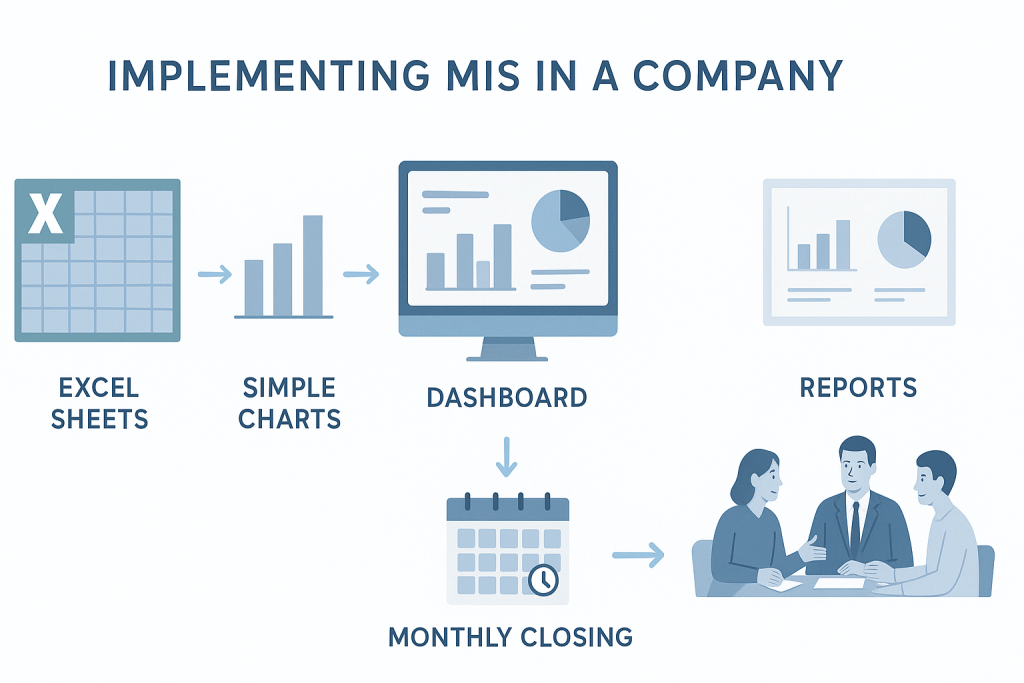
You don’t need complex software to begin. Follow these simple steps:
- Start with Excel-based MIS templates.
Include P&L, cash flow, receivables ageing, and expense summary. - Fix a monthly closing date.
Ensure accounts are updated within 3–5 days of month-end. - Appoint one person (internal or outsourced CFO) responsible for MIS.
- Schedule a monthly review meeting.
Discuss the MIS with your core team — not just finance people. - Gradually automate.
Move to tools like Power BI, Zoho Analytics, or Tally Dashboard once your data flow is consistent.
- Start with Excel-based MIS templates.
7. MIS: Your Roadmap to Smarter, Faster Growth
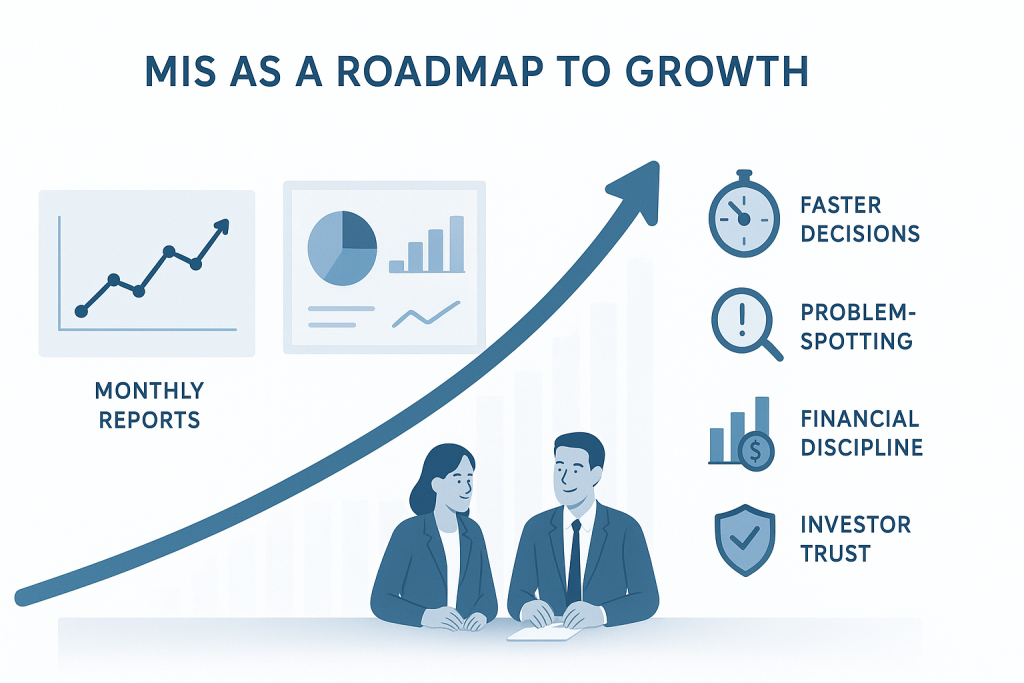
In today’s competitive environment, businesses that monitor performance monthly grow faster — and fail less often.
A structured MIS helps you:
- Make faster, confident business decisions.
- Spot problems before they become crises.
- Build financial discipline in your organization.
- Enhance your valuation and investor trust.
In short — “What gets measured, gets managed.”
Need Help Setting Up Monthly MIS?
At Vizttax, we act as your Finance Partner — not just accountants.
Our CFO Service includes:
- Monthly MIS & analysis
- Budgeting and cash flow planning
- Profitability improvement strategies
- Compliance & tax monitoring
Let’s build a financial control system that helps your business grow smarter every month.
Visit www.vizttax.com