
GST on Bricks in India: GST Rate, ITC Eligibility, Claim Process & Common Issues
Construction businesses, builders, contractors, developers, and manufacturers regularly purchase bricks as a major raw material. Under the GST regime, the taxation structure on bricks has changed significantly over the years, especially regarding GST rates and Input Tax Credit (ITC).
Many taxpayers still face confusion regarding:
- Applicable GST rate on bricks
- Whether ITC can be claimed
- Situations where ITC gets blocked
- Documentation requirements
- GST compliance risks
Incorrect GST treatment may result in ITC reversal, notices, interest, and penalties. Therefore, understanding GST on bricks is extremely important for every business involved in construction or infrastructure activities.
Introduction to GST on Bricks
Bricks are one of the most commonly used construction materials in India. They are used in:
- Residential projects
- Commercial buildings
- Warehouses
- Factories
- Infrastructure projects
- Government contracts
Under GST, bricks are taxable goods and the applicable GST rate depends upon the scheme opted by the supplier.
The GST treatment becomes more important because Input Tax Credit on construction-related goods is often disputed under Section 17(5) of the CGST Act.
GST Rate on Bricks
Currently, bricks generally attract the following GST rates:
| Type of Supply | GST Rate | ITC Availability |
|---|---|---|
| Bricks supplied under regular GST scheme | 12% | ITC Available |
| Bricks supplied under concessional scheme | 6% | ITC Not Available |
The supplier has the option to choose the applicable scheme subject to legal conditions.
HSN Codes for Bricks
| Product Type | HSN Code |
|---|---|
| Clay bricks / Building bricks / Fly ash bricks | 6901 |
| Ceramic construction bricks | 6904 |
| Certain construction materials | 6815 |
Correct HSN classification is important because wrong classification may lead to GST disputes and penalties.
Major GST Changes in Brick Industry
1. Increase in GST Burden
The GST framework for bricks has changed significantly after various GST Council recommendations.
Many brick suppliers who earlier operated under lower effective tax structures now have to comply with revised GST schemes.
2. Dual Tax Structure
Now the industry largely operates under two structures:
- 12% GST with ITC
- 6% GST without ITC
This creates pricing differences in the market and directly affects buyers.
3. Compliance Burden Increased
Brick manufacturers and suppliers now face:
- GST registration requirements
- Invoice compliance
- E-way bill compliance
- Return filing obligations
- ITC reconciliation requirements
What is Input Tax Credit (ITC)?
Input Tax Credit means credit of GST paid on purchases which can be adjusted against GST liability on sales.
Example
Suppose:
- A builder purchases bricks worth ₹5,00,000
- GST charged = 12%
- GST paid = ₹60,000
If eligible, the builder can claim ₹60,000 as ITC and use it against output GST liability.
This reduces overall tax cost and avoids cascading taxation.
Whether ITC on Bricks is Available?
Yes, ITC on bricks is generally available subject to fulfilment of GST conditions.
ITC can usually be claimed when:
- Supplier charges GST under 12% scheme
- Buyer is GST registered
- Bricks are used for business purposes
- Construction relates to taxable outward supply
- Proper tax invoice is available
- Invoice reflects in GSTR-2B
- Supplier has deposited GST
Situations Where ITC on Bricks Gets Blocked
This is one of the most important practical areas under GST.
Even if GST is paid, ITC may still become ineligible in certain situations.
1. Construction of Immovable Property on Own Account
Under Section 17(5) of the CGST Act, ITC may be blocked if bricks are used for construction of immovable property on own account.
Examples
- Office building construction
- Factory building construction
- Self-owned commercial premises
- Residential house construction
In such cases, ITC may not be available.
2. Supplier Opts for 6% GST Scheme
If supplier pays GST at concessional 6% rate without ITC benefit, the buyer cannot claim ITC.
Therefore, buyers should always verify supplier tax structure before purchasing.
3. Personal or Non-Business Use
Bricks used for:
- Personal house
- Farm house
- Non-business projects
do not qualify for ITC.
4. Missing or Defective Invoice
ITC may be denied if:
- Invoice is missing
- GSTIN is incorrect
- Invoice is not uploaded by supplier
- ITC not reflected in GSTR-2B
- Invoice lacks mandatory details
5. Supplier Non-Compliance
If supplier:
- Does not file GST returns
- Does not deposit tax
- Becomes non-compliant
then ITC disputes may arise for the buyer.
Step-by-Step Process to Claim ITC on Bricks
Step 1: Purchase from GST Registered Supplier
Always verify:
- GST registration status
- GST rate
- Supplier compliance
- Invoice details
Step 2: Obtain Proper Tax Invoice
Invoice should contain:
- Supplier GSTIN
- Buyer GSTIN
- Invoice number
- Invoice date
- HSN code
- GST amount
Step 3: Verify GSTR-2B Reflection
Ensure the invoice appears in GSTR-2B before claiming ITC.
Monthly reconciliation is highly recommended.
Step 4: Ensure Business Usage
Maintain records showing bricks are used for taxable business activity.
Step 5: Claim ITC in GSTR-3B
Eligible ITC should be claimed while filing GSTR-3B return.
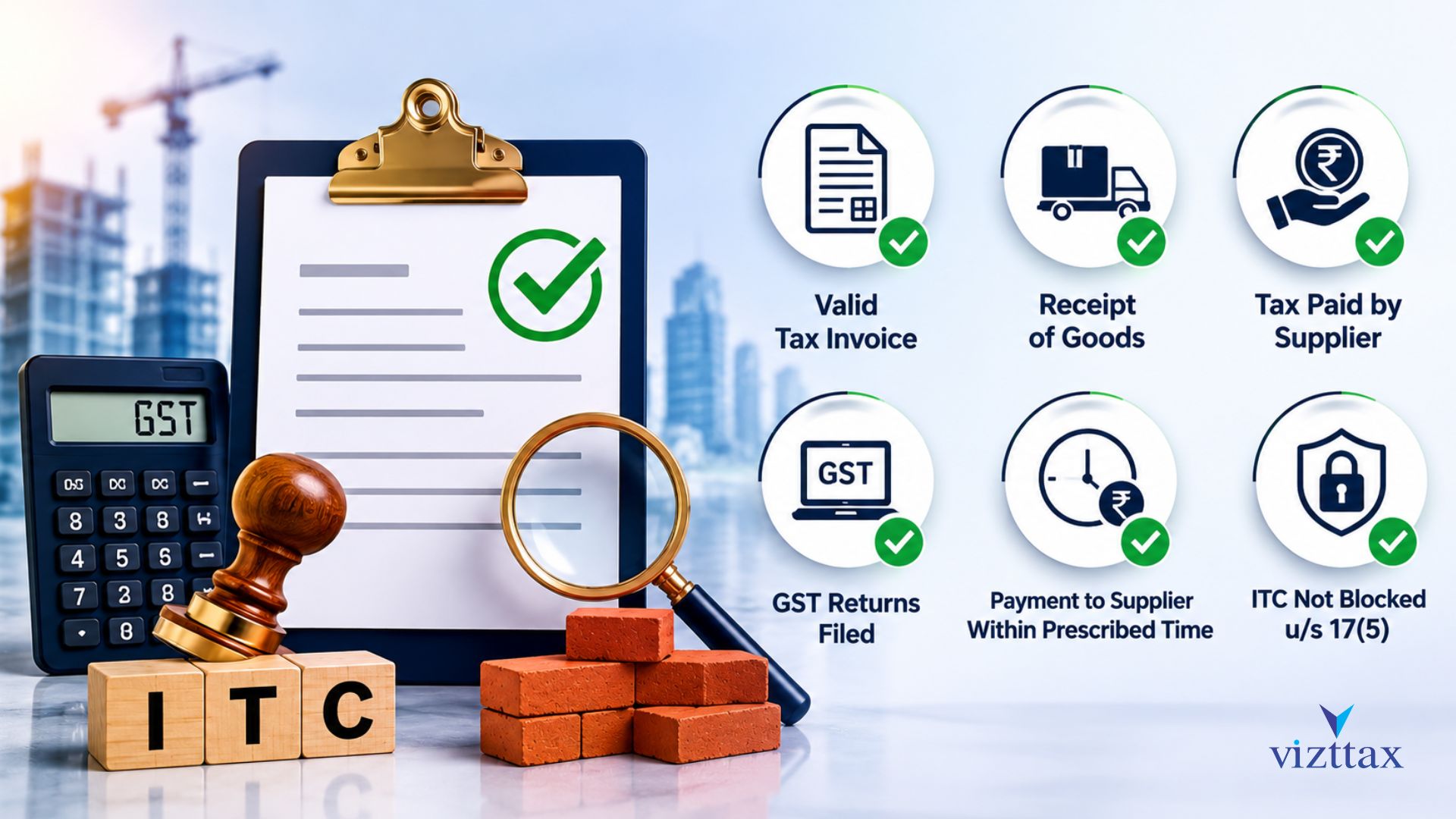
Important Conditions for Claiming ITC
Under Section 16 of the CGST Act, the following conditions must be fulfilled:
- Possession of valid tax invoice
- Receipt of goods
- Tax paid by supplier
- GST returns filed
- Payment to supplier within prescribed time
- ITC should not be blocked under Section 17(5)
Failure to satisfy any condition may result in ITC disallowance.
Time Limit for Claiming ITC
ITC relating to a financial year can generally be claimed up to:
- 30th November of next financial year, or
- Date of filing annual return,
whichever is earlier.
Delayed claims may lapse permanently.
Practical Compliance Tips
Maintain Vendor Verification System
Before purchasing bricks:
- Verify GST registration
- Check filing compliance
- Confirm tax structure
Perform Monthly Reconciliation
Regular reconciliation of:
- Purchase register
- GSTR-2B
- Supplier invoices
helps reduce future notices.
Maintain Proper Construction Records
Keep:
- Site records
- Purchase records
- Consumption details
- Work orders
- Tax invoices
Analyse Section 17(5) Carefully
Many taxpayers wrongly claim ITC without checking blocked credit provisions.
Professional review is advisable for large construction projects.
Frequently Asked Questions (FAQs)
1. What is the GST rate on bricks in India?
Bricks generally attract either:
12% GST with ITC, or
6% GST without ITC.
2. Can a builder claim ITC on bricks?
Yes, builders can claim ITC subject to fulfillment of GST conditions and provided the credit is not blocked under Section 17(5).
3. Is ITC available for personal house construction?
No, ITC is generally not available for personal or residential construction used for non-business purposes.
4. Can ITC be claimed if invoice is not reflected in GSTR-2B?
Claiming ITC without GSTR-2B reflection may create litigation and compliance risks.
5. Is ITC available if supplier charges 6% GST?
No, ITC is generally not available where supplier opts for concessional 6% GST scheme without ITC.
6. What happens if supplier does not deposit GST?
The department may dispute ITC eligibility and initiate proceedings against the buyer.
7. Which section blocks ITC on construction-related expenses?
Section 17(5) of the CGST Act contains blocked credit provisions.
8. Is ITC available on bricks used in factory construction?
In many cases, ITC may get blocked if factory building is constructed as immovable property on own account.
9. What documents are required for claiming ITC?
Generally required documents include:
Tax invoice
GSTIN details
GSTR-2B reflection
Purchase records
Payment proof
10. What is the time limit to claim ITC?
ITC can generally be claimed up to 30th November of the next financial year or filing of annual return, whichever is earlier.